What Is Teleradiology? A Complete Guide for Hospitals & Imaging Centers in 2026
Radiology has always demanded precision — yet access to specialized expertise has traditionally been limited by geographical boundaries. For decades, timely and accurate diagnostic interpretation depended largely on the availability of a qualified radiologist at the point of care.
Teleradiology changed that entirely. Today, a hospital in a rural community can access the same subspecialty expertise as a major academic medical centre — at any hour, on any day. And in 2026, with imaging volumes growing at roughly 15% annually against a radiologist workforce growing at just 2%, teleradiology is not a convenience. It is a clinical necessity.
This guide explains what teleradiology is, how it works, who uses it, what it costs, why healthcare facilities depend on it, and what to look for when evaluating a teleradiology partner.
What Is Teleradiology?
Teleradiology is the electronic transmission of medical images — X-rays, CT scans, MRIs, ultrasounds, mammograms — from one location to another for interpretation by a qualified radiologist who is not physically present at the facility.
The radiologist reviews the images on a high-resolution diagnostic workstation, generates a report, and transmits that report back to the referring physician or facility — all within a matter of minutes, in most cases.
Teleradiology does not change what is being interpreted. It changes where and when the interpretation can happen.
This distinction matters. The clinical authority, diagnostic accuracy, and report quality remain with the board-certified radiologist who signs the report — regardless of their physical location.
How Does Teleradiology Work?
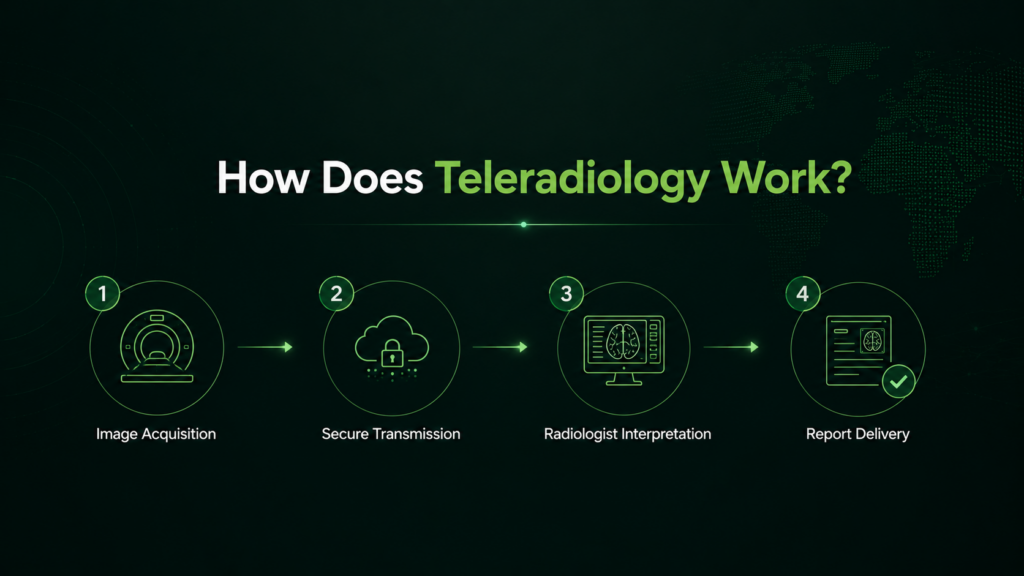
- 1. Image Acquisition :
A patient undergoes a scan at the facility — a CT, MRI, X-ray, ultrasound, or another modality. The images are captured in DICOM format, the international standard for medical imaging files.
- 2. Secure Transmission :
The DICOM study is transmitted from the facility's PACS (Picture Archiving and Communication System) to the teleradiology provider's infrastructure over an encrypted, HIPAA-compliant connection. In modern workflows, this is fully automated — studies are routed the moment the scan is completed, with no manual upload required.
- 3. Radiologist Interpretation :
The study is assigned to a radiologist matched by subspecialty — a neuro case goes to a neuroradiologist, a musculoskeletal case to an MSK specialist. The radiologist reviews the images on a calibrated diagnostic monitor and generates a structured report. For AI-assisted platforms, the scan is analysed before the radiologist sees it, flagging critical findings and pre-drafting a structured report for review and finalisation.
- 4. Report Delivery :
The finalised report is transmitted back to the originating facility's PACS or hospital information system. The referring clinician accesses the report alongside the original images. For typical outpatient studies, the entire cycle — acquisition to signed report — is routinely completed in 30 to 60 minutes. STAT emergency reads can be delivered in under 20 minutes.
What Types of Services Does Teleradiology Cover?
- 24/7 Subspecialty Reporting — round-the-clock access to expert neuroradiology, MSK, pediatric, chest, abdominal, cardiothoracic, and trauma imaging specialists.
- Nighthawk & After-Hours Coverage — reliable overnight teleradiology for emergency departments and after-hours workflows where on-site coverage is unavailable.
- Preliminary & Final Reads — fast preliminary reports for urgent cases, followed by comprehensive final interpretations by senior subspecialty radiologists.
- STAT & Urgent Case Reporting — prioritised reads for time-sensitive cases where diagnostic delays carry direct clinical risk.
- Second Opinion Reads — trusted second opinions for CT, MRI, PET, and X-ray studies, helping clinicians and patients gain diagnostic clarity.
- Peer Review & Quality Assurance — structured peer review workflows that strengthen diagnostic quality, support accreditation, and improve reporting consistency.
Who Uses Teleradiology?
Teleradiology serves a wide range of healthcare settings — each with its own workflow needs, volume pressures, and coverage requirements:
- Community and Rural Hospitals -
Hospitals in smaller or rural communities often cannot justify the cost of employing a full-time subspecialty radiologist. Teleradiology gives these facilities access to the same level of expertise as major urban medical centres — neuroradiology, MSK, pediatric imaging, and more — without the overhead of on-site staffing.
- Emergency Departments -
Emergency medicine depends on speed. Trauma activations, stroke codes, and critical overnight cases demand STAT reads that on-call radiologists alone cannot reliably sustain. Teleradiology networks provide 24/7 emergency coverage with sub-20-minute turnaround times, keeping clinical decision-making moving at the pace emergencies require.
- Diagnostic Imaging Centers -
Outpatient imaging centers use teleradiology to manage read volume without the overhead of in-house radiologist staffing. For many centers, teleradiology is the entire operational model — a network of remote radiologists handling all interpretations, with reports delivered in well under an hour.
- Teleradiology Companies -
Organisations that provide teleradiology services at scale — managing large distributed networks of radiologists reading for multiple facilities — increasingly rely on AI-powered workflow platforms to maintain consistency, speed, and quality across thousands of reads per week.
- Academic Medical Centers -
Even large, well-staffed academic hospitals use teleradiology to extend overnight and weekend coverage, and to access subspecialty expertise in lower-volume imaging categories where it would not be economically viable to maintain a full-time on-site specialist.